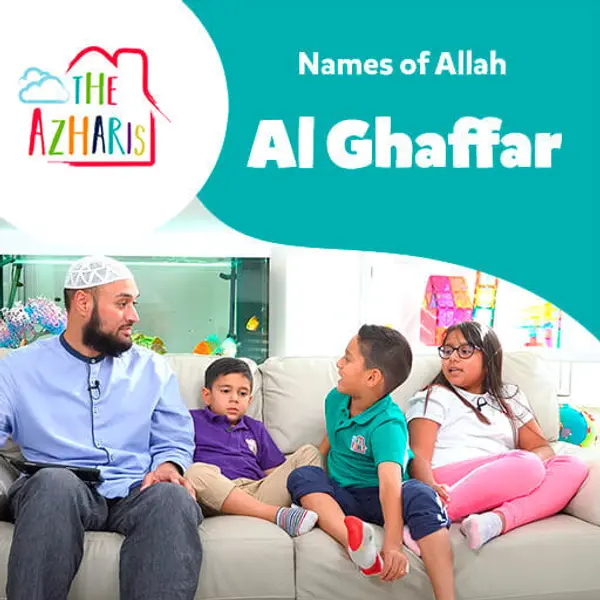
Names of Allah: Al Hameed
Sheikh Azhari and his children learn Allah's name Al-Hameed, the Praiseworthy, the bedtime tasbih, and the story of Qarun's treasure. Ages 4 to 9.
Start with a 7-day free trial.

What is Names of Allah: Al Hameed about?
Names of Allah: Al Hameed is an Islamic video for children aged 4 to 9 in which Sheikh Azhari and his children learn about Al-Hameed, the Praiseworthy, one of the beautiful names of Allah. It is the last episode of the series.
What does it mean to praise someone? One of the children explains: telling them they have done well, like "excellent colouring". Praise is a kind of thanks. Everything good comes from Allah, so all praise belongs to Him, and that is why the first words of Surah Al-Fatiha, which we recite in every prayer, are "Alhamdulillah", all praise is for Allah.
The Sheikh shares a bedtime tip from the Prophet ﷺ: before sleep, say "SubhanAllah" 33 times, "Alhamdulillah" 33 times and "Allahu Akbar" 34 times. That makes a hundred, and with every good deed worth ten, a thousand good deeds each night.
In story time, he tells of Qarun, one of the people of Prophet Musa (AS). Qarun had so much treasure that just carrying the keys to it was heavy for a group of strong men. But he was proud and did not thank Allah, so Allah made the earth swallow him and his house.
The more we say Alhamdulillah, the more Allah gives us. And who thanked Allah most of all? The Prophet Muhammad ﷺ. The Sheikh tells how, when the Prophet ﷺ and Abu Bakr left Makkah for Madinah, a rider chased them, but his horse's legs sank into the ground and he could not reach them. The children act it out with their hands: clippity-clop, clippity-clop.
What your child will learn
- Allah is Al-Hameed: all praise belongs to Him.
- Alhamdulillah means all praise and thanks are for Allah.
- Saying the tasbih before sleep brings a great reward.
- Qarun was proud and did not thank Allah, and lost everything.
- The more we thank Allah, the more He gives us.
Where this video comes from
- Surah Al-Fatiha 1:2: All praise is for Allah, Lord of the worlds.
- Sahih al-Bukhari 3113: The Prophet ﷺ taught Ali and Fatimah to say SubhanAllah 33 times, Alhamdulillah 33 times and Allahu Akbar 34 times when going to bed.
- Surah Al-Qasas 28:76-81: Qarun, of the people of Musa, had treasures whose keys were a burden for a band of strong men; he was proud, and Allah made the earth swallow him and his house.
- Surah Ibrahim 14:7: If you are grateful, I will surely give you more.
- Sahih al-Bukhari 3615: On the journey to Madinah, the legs of Suraqah's horse sank into the ground as he chased the Prophet ﷺ and Abu Bakr.
Talk about it afterwards
- What does it mean to praise someone?
- What do we say before sleep to earn a thousand good deeds?
- Why did Qarun lose all his treasure?
- What are three things you can say Alhamdulillah for today?
Words to know
- Al-Hameed
- The Praiseworthy; a name of Allah.
- Alhamdulillah
- All praise and thanks are for Allah.
- SubhanAllah
- Glory be to Allah.
- Allahu Akbar
- Allah is the Greatest.
- Tasbih
- Glorifying Allah with words like these, often counted.
Frequently asked questions
What age is Names of Allah: Al Hameed suitable for?
Children aged 4 to 9. It is a relaxed family conversation, with two short stories and a bedtime tasbih children can learn.
Does Names of Allah: Al Hameed have music?
No. It is music-free.
What does Names of Allah: Al Hameed teach children?
That all praise belongs to Allah, how to say the tasbih before sleep, and, through the story of Qarun, why we thank Allah for what He gives us.