Names of Allah: At Tawaab
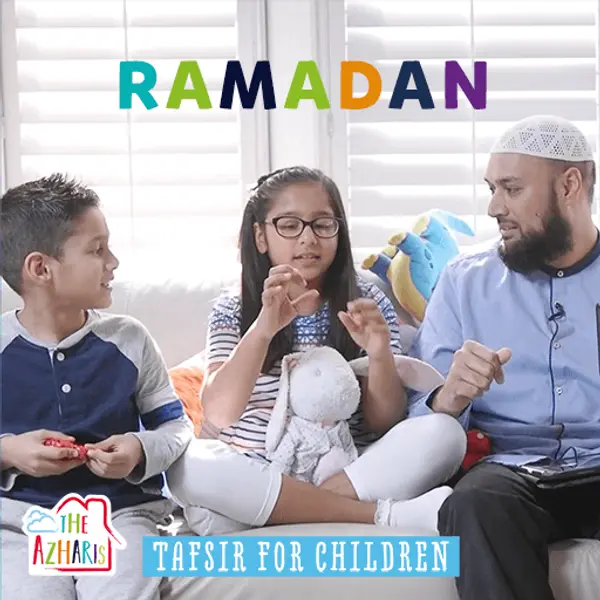
Sheikh Azhari and his children learn Allah's name At-Tawwab, who accepts our repentance, with the man who killed 100 people. Ages 4 to 9.
Start with a 7-day free trial.

What is Names of Allah: At Tawaab about?
Names of Allah: At Tawaab is an Islamic video for children aged 4 to 9 in which Sheikh Azhari and his children learn about At-Tawwab, the One who accepts repentance, one of the beautiful names of Allah.
It starts with a boomerang. What does a boomerang do? You throw it and it comes back. The Sheikh uses it to show what it means to turn back to Allah. If we say something we should not have said, we say sorry to Mummy and Daddy; if we did not listen to Allah, we say "Astaghfirullah". Prophet Adam (AS) made a mistake when he ate from the tree, and he said sorry to Allah. And the Prophet Muhammad ﷺ asked Allah for forgiveness more than seventy times every day.
In story time, one of the children helps tell the hadith of the man who killed a hundred people. A learned man told him that he could still repent, and to leave for a town of good people. He died on the way, and the angels measured the distance: he was closer to the good town, so the angels of mercy took him.
Then the Sheikh tells the hadith of the last person to enter Jannah, who kept asking Allah for a little more, even after he had promised not to, until Allah brought him in.
The episode ends with fire and water. Water puts out fire, and good deeds wipe away bad deeds. Children learn that it is never too late, as long as we are alive, to turn back to Allah.
What your child will learn
- Allah is At-Tawwab. He accepts our repentance whenever we turn back to Him.
- When we disobey Allah, we say "Astaghfirullah" and ask Him to forgive us.
- It is never too late, as long as we are alive, to turn back to Allah, however many wrong things we have done.
- Good deeds wipe away bad deeds, as water puts out a fire.
- We should keep making dua and asking Allah, as the last man to enter Jannah did.
Where this video comes from
- Surah Al-Baqarah 2:37: Adam received words from his Lord, and Allah accepted his repentance. He is the Accepting of Repentance (at-Tawwab), the Merciful.
- Sahih al-Bukhari 6307: The Prophet ﷺ said he asked Allah for forgiveness and turned to Him in repentance more than seventy times a day.
- Sahih al-Bukhari 3470: The man who killed ninety-nine people, then a hundred, set out for a town of good people, died on the way and was forgiven.
- Sahih Muslim 2766: The same hadith of the man who killed a hundred people, with the angels of mercy and of punishment measuring the land.
- Sahih Muslim 186: The last man to come out of the Fire and enter Jannah, who asks Allah for more after each promise.
- Surah Hud 11:114: Good deeds do away with bad deeds.
Talk about it afterwards
- How is turning back to Allah like a boomerang?
- What did Prophet Adam (AS) do after his mistake?
- Why did the angels of mercy take the man who had killed a hundred people?
- What good deed could you do today?
Words to know
- At-Tawwab
- The One who accepts repentance, again and again; a name of Allah.
- Astaghfirullah
- I ask Allah to forgive me.
- Jannah
- Paradise.
- Jahannam
- The Fire, Hell.
Frequently asked questions
What age is Names of Allah: At Tawaab suitable for?
Children aged 4 to 9. It is a relaxed family conversation with two short hadith stories. One of them is about a man who killed people, told simply and without detail.
Does Names of Allah: At Tawaab have music?
No. It is music-free.
What does Names of Allah: At Tawaab teach children?
That Allah accepts the repentance of anyone who turns back to Him, that we say Astaghfirullah when we do wrong, and that good deeds wipe away bad ones.