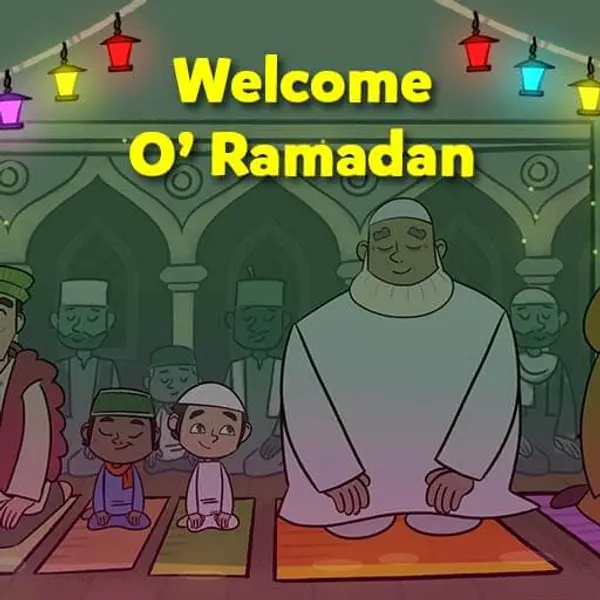
Tafseer: Surah An-Nasr
Sheikh Azhari and his children learn Surah An-Nasr, what SubhanAllah and Alhamdulillah mean, and how Allah wipes away our mistakes. Ages 4 to 9.
Start with a 7-day free trial.

What is Tafseer: Surah An-Nasr about?
Tafseer: Surah An-Nasr is an Islamic video for children aged 4 to 9 in which Sheikh Azhari and his children explore the meaning of Surah An-Nasr, one of the shortest surahs of the Qur'an, and the words of remembrance it teaches.
Which was the last whole surah to be revealed? The children know: An-Nasr. The Sheikh explains its first words. Al-fath does not mean "big and fat", as one child asks, but the opening of Makkah, when the Prophet Muhammad ﷺ entered the city. People had said they would believe in him once he did, and then, as the surah says, people entered Islam in crowds. To show what a crowd is, the Sheikh reminds the children of all the people on an aeroplane.
Next, Allah tells the Prophet ﷺ to glorify Him. So what does SubhanAllah mean, the words we say 33 times after we pray? It means that Allah is far above anything bad. The Sheikh adds that the Prophet ﷺ said it when something shocked him, and owns up to saying it when the family's fish tank leaked. Alhamdulillah means all good is due to Allah, so we say it when something good happens.
The surah ends with one of Allah's names, At-Tawwab. Like a boomerang that comes back, we turn back to Allah after a mistake, and He can wipe our bad deeds away as if they had never been there, like scribbles wiped off a wall.
The episode is relaxed and funny, with a toy dinosaur called Frankiosaurus joining in the questions.
What your child will learn
- Surah An-Nasr tells how people entered Islam in crowds after the opening of Makkah.
- SubhanAllah means that Allah is far above anything bad.
- Alhamdulillah means all good is due to Allah, so we say it when something good happens.
- Allah is At-Tawwab. When we turn back to Him after a mistake, He can wipe our bad deeds away.
Where this video comes from
- Surah An-Nasr 110:1-3: When the help of Allah and the victory come, and you see the people entering the religion of Allah in crowds, glorify the praises of your Lord and ask His forgiveness. He is ever accepting of repentance.
- Sahih Muslim 3024: Ibn Abbas said the last surah to be revealed complete was "Idha ja'a nasrullahi wal-fath".
- Sahih al-Bukhari 4302: The Arabs waited to accept Islam until the opening of Makkah, saying that if he overcame his people he was a true prophet; after it, every tribe hurried to accept Islam.
- Sahih Muslim 597: Whoever says SubhanAllah 33 times, Alhamdulillah 33 times and Allahu akbar 33 times after every prayer.
Talk about it afterwards
- What happened after the Prophet ﷺ entered Makkah, according to Surah An-Nasr?
- What does SubhanAllah mean, and when do we say it?
- Why is a boomerang a good way to remember the name At-Tawwab?
- What can you do the next time you make a mistake?
Words to know
- Tafseer
- Explaining the meaning of the Qur'an.
- Al-Fath
- The opening, or victory; in this surah, the opening of Makkah.
- SubhanAllah
- Glory be to Allah; Allah is far above anything bad.
- Alhamdulillah
- All praise and thanks are for Allah.
- At-Tawwab
- The One who accepts repentance again and again; a name of Allah.
Frequently asked questions
What age is Tafseer: Surah An-Nasr suitable for?
Children aged 4 to 9. The Sheikh explains each ayah with everyday examples, like an aeroplane full of people and a boomerang.
Is Tafseer: Surah An-Nasr based on the Qur'an?
Yes. It explains the three ayat of Surah An-Nasr, the 110th surah of the Qur'an, and the words of dhikr they teach.
How long is Tafseer: Surah An-Nasr?
About 7 minutes. It is music-free.