
Is YouTube Haram for Kids?
An Honest Answer for Muslim Parents
12 min read Areeba Hasan

Summary
YouTube as a platform is not inherently haram, but letting your child use it unsupervised is like leaving them alone in a busy city square. This guide walks through the reality of YouTube and screen time in this digital age. We discuss why the algorithm matters more than individual content, how to think about “halal screen time” from an Islamic perspective, and a practical framework for judging an app – so you can make informed decisions with confidence, rather than guilt.
Is YouTube haram for kids?
Short answer: YouTube as a platform is not inherently haram. But using it unsupervised is akin to leaving your child alone in a busy city square. Regarding screen time, Islam does not ban technology. It guides how we use them.
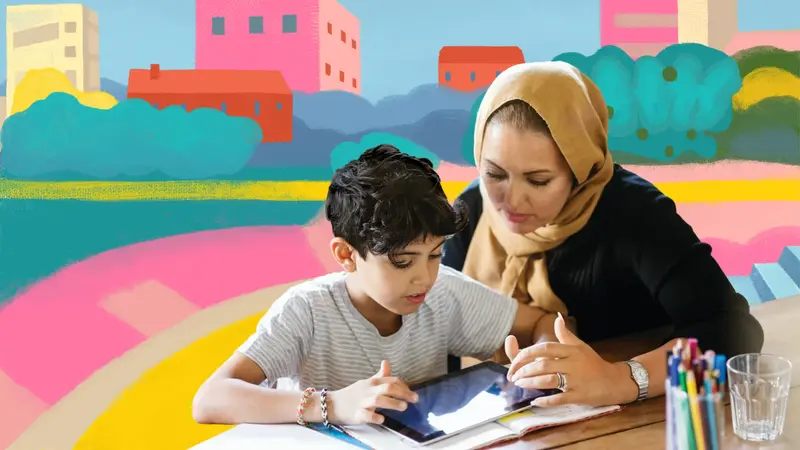
If you have been lying awake wondering whether you are failing your child by handing over the tablet, you are not alone. This is one of the most frequently asked questions in Muslim parenting, and almost all answers online are either a one-line ruling or a blog that avoids the question entirely.
Before we go further, we should say this clearly: we make an app. Our own children use screens. We are not going to tell you to throw the tablet in a drawer. You gave your child the tablet because you were busy cooking dinner, on a work call or simply exhausted. That does not make you a bad parent. It makes you a parent.
YouTube is also free, which matters enormously. For families who cannot afford to pay for children’s media, it is often the only option available. It is also where a generation of Muslim creators have built genuinely good work: nasheeds, Arabic lessons and Qur’an recitations. Storytellers and teachers on YouTube explain things better than most textbooks. Some of it is excellent, and some of it exists nowhere else. A child in Manchester can hear a scholar in Cairo. A family in Sydney can watch tawaf live during Hajj. That reach did not exist twenty years ago.
Used with a parent in the room, chosen deliberately, watched and then closed, YouTube can be a good thing in a Muslim home.
"According to Islamic principles, the use of apps is permissible in Islam, provided that their purpose is halal, they are used in moderation, and they are in accordance with good morals and Islamic values."
Molvi Noorullah, Mufti, Tamil Nadu, India, Secretary, Noon Foundation
The concern is narrower than most articles suggest. It is not the platform, and it is not the creators. It is what happens when a young child is left alone with autoplay.
Why is YouTube Kids not as safe as we think?
Most parents assume YouTube Kids handles children’s safety. The content is filtered, the app is built for children, and the unsuitable material is screened out. That filtering is real, and it does work most of the time.
However, the content is only half of it.
YouTube’s algorithm is built to maximise watch time. It learns what holds your child’s attention and serves more of it, then more again. Your child does not choose what comes next. A recommendation system does, and its purpose is engagement rather than your child’s wellbeing.
This is how a child can start on an innocent nursery rhyme and, within three autoplay clicks, land somewhere you would not have chosen – the system worked as designed.
This is usually what Muslim parents are sensing when they ask whether YouTube is haram. It is rarely a specific video that worries them. It is the feeling of having handed their child to something they do not control.
"I think for me and other parents, the worry is that screens are ruining their brain, more than thinking about physical health. It's the concentration and that they're not doing anything educational or useful for themselves."
Abrar Hammuda, Parent and Islamic Studies Teacher, Fitra Madrasah, Surrey, UK
That instinct is sound, and it deserves a framework rather than guilt.
Content or design: the real issue?
Here is the distinction that makes the rest of this clearer.
A tool is something you control. A hammer does not decide what you build. A book does not turn its own pages. You pick it up, you use it, you put it down.
An environment is different. It has its own pull, its own logic. A marketplace is an environment. So is a playground. You do not fully control what happens inside it.
YouTube is offered as a tool. Autoplay turns it into an environment.
Once you see the distinction, the question changes. You are no longer asking whether a video is permissible. You are asking whether you want your child standing in this environment, unsupervised, for an hour at a time.
This is where the Islamic concept of amanah becomes practical rather than abstract. Your child’s mind and their fitrah, their natural disposition towards good, are a trust given to you by Allah. So is their time. Time in Islam is not a neutral resource. It is something we are answerable for. The Prophet ﷺ taught that on the Day of Judgment, we will be asked how we spent our time and how we raised our young.
When a system is designed to hold your child’s attention as much as possible, it is not competing with your parenting. It is quietly working around it.
Understanding why screen time is bad in this specific sense, as a design problem rather than a library of bad videos, is what lets you make decisions calmly.
What does a balanced approach look like in a Muslim home?
Islam consistently points towards wasatiyyah, the middle path. In the context of screens, that can mean avoiding both extremes: total digital isolation and unmonitored exposure.
Here is what that looks like in practice.
Step one: separate tools from environments
Before allowing an app, ask one question: does this end, or does it keep going?
An audiobook ends. A story ends. Games usually have a final level. Autoplay does not end, and it was never built to. This single question will sort most of what your child asks for, including the parts of YouTube that are fine.
"As Islamic principles guide: parents should monitor their children's use of apps and guide them properly. The use of apps should not be so excessive that it negatively affects prayer, recitation of the Qur'an, education, or family responsibilities."
Molvi Noorullah, Mufti, Tamil Nadu, India
Step two: replace rather than remove
Taking something away without offering anything in its place creates resentment, and it rarely lasts. The families who manage this well are usually not the strictest. They are the ones with better things on hand.
For instance, a child listening to a story while you cook is in the room, engaged, and learning. Their eyes are free. The concept of tarbiyah, holistic nurturing, applies here: the screen time should actively support your child’s character development and moral learning, not hinder it.
Screen free time does not have to mean silence or boredom. Practical screen free activities for kids aged four to eleven include audio stories on car journeys, drawing along to a story, acting out what they have just heard, and building or making something while they listen. Non-screen activities tend to stick when they run alongside something rather than replacing entertainment with nothing.
Step three: tell them why
“Because I said so” builds compliance. Explaining the reason builds judgement.
Try something closer to this: “YouTube is built by very clever people to make you want to keep watching, even after you have had enough. Your time is worth protecting. So we choose things that end when they end.”
Children understand this better than most adults expect. They also start noticing it for themselves, which is the actual goal.
What is halal screen time?
Halal screen time moves away from passive, ad-driven scrolling towards intentional, value-based engagement. It protects your child’s fitrah – their natural inclination towards goodness – while supporting tarbiyah, their holistic development as a Muslim.
To turn screen time into halal screen time, look for these key criteria:
- Ad-free: No unwanted commercial influence, no pop-ups pulling your child in unexpected directions, no data collection. Advertising to children is not just a distraction, it is a system designed to shape desires. An ad-free environment lets your child’s own interests lead.
- Scholar and educator reviewed: Ensures historical and religious accuracy in stories of the Qur’an, Hadith, and the Prophets. This is not just about avoiding bad content. It is about ensuring that your child learns about Islam from people who know it, not from algorithms trained on the Internet.
- Active learning over passive consumption: Interactive stories, games that require thinking, and content that invites participation – this supports adab, the refinement of character, because it engages rather than numbs.
- Offline capability: Your child can download and use content without constant Internet access. This means you control when and how they use it, and whether they are exposed to an unfiltered connection.
- Parental controls that actually work: Real tools to manage what, when, and how long.
When you combine these elements, screen time becomes something you can stand behind rather than feel guilty about.
"Miraj Stories has been really good at getting our son to engage with some of the fundamentals of Islam. Things like learning the Arabic alphabet, stories about the prophet and his character, etc., have all been subtle ways of Yusuf learning about Islam through fun and context, rather than being taught about something that would otherwise be quite abstract for a young child."
Mo Alvi, Parent and Miraj user, UK
How do you evaluate any app?
Use this for YouTube, the game a friend recommended, or whatever your child asks about next. Give one point for each box an app ticks.
| What to check | Autoplay video apps | What you want |
|---|---|---|
| Does it end? | Infinite | Finite. It finishes |
| Who chooses what is next? | The algorithm | Your child, or you |
| Ads? | Yes | None |
| Must they keep their eyes on the screen the whole time? | Always | Audio option, gives their eyes a break |
| Works offline? | No | Yes |
| Can you turn music off? | No | Yes |
| Real parental controls? | Limited | Genuine control |
The point of the framework is not to condemn one app. It is to give you something practical, because you will be answering this question again in six months about something that does not exist yet.
It also lets you use YouTube deliberately rather than defensively. A chosen video, with autoplay off, in a room with you in it, scores far better than the same video watched alone at the end of a long day.
What does a passing option look like?
An app that scores well feels different, and most parents notice this within a day. Your child picks something, finishes it, and stops. Nothing keeps pulling them to the next thing.
In practice, that means a library chosen by humans rather than an algorithm: no ads, audio-only options, downloadable content for offline use, music you can toggle, and real parental controls. Content should be reviewed not only for safety but for Islamic alignment.
This is what we built with Miraj Stories.
"When my children are on Miraj, I'm happy because at least it's benefiting him. He's learning something."
Abrar Hammuda, Parent and Islamic Studies Teacher, Fitra Madrasah, Surrey, UK
Miraj Stories is a multi-media Islamic library designed specifically for Muslim families with children aged 4 to 9. Built by Muslim parents and educators, it offers scholar-approved content that brings Islamic teachings to life.
Inside Miraj Stories for children aged 4–9
Interactive Books
Drag, click, and trace activities that build motor skills while teaching core Islamic concepts: Salah, Wudu, the Five Pillars, and stories of the Prophets. Active learning supports adab and keeps children engaged, rather than passive consumption.
Soothing Audiobooks
Perfect for Islamic bedtime routines, car rides, and screen-free listening. Stories of the Prophets, Muslim heroes and Qur’anic surahs. Your child listens while drawing, building, or playing — their eyes are free and their hands stay busy.
Arabic and Islamic Games
Puzzles and letter-tracing games that make learning Arabic fun and intuitive. No ads, no timers, no pressure. Just learning at your child’s pace.
Character and Akhlaq Khutbahs
Kid-friendly lessons on kindness, anger management, respect, and good manners. Direct teaching of the values you are trying to build at home.
No-Music Mode
For families who prefer their children’s content without music, you can toggle music off across the entire app. This is the single objection we hear most often from Muslim parents, and it is a setting rather than a compromise.
Offline Content Accessibility
Everything can be downloaded so your child can listen during a long journey without an unfiltered Internet connection. Access is yours to decide.
We are not going to claim an app replaces parenting. It does not. But it can give you twenty minutes to cook dinner without feeling guilty.
Key takeaways
- YouTube is not inherently haram, and there is genuinely good Muslim content on it. The concern is autoplay, not the platform
- Your child's mind, fitrah and time are an amanah, a sacred trust you are answerable for
- Wasatiyyah means avoiding extremes: in children’s content, that can mean avoiding both digital isolation and unmonitored exposure
- Halal screen time protects your child's fitrah while supporting their tarbiyah. Look for: ad-free, scholar-reviewed, active learning, offline and real parental controls
- Use the seven-point framework to judge any app. Replace rather than remove. Screen time works best when something good is on offer
Frequently asked questions
Is YouTube haram for my child?
The platform is not inherently haram, and much of its content is entirely permissible. Some of it is genuinely valuable, including a great deal of Muslim work that exists nowhere else. The concern is the design. Autoplay means your child is guided by a system optimised for watch time rather than for their wellbeing. Watched deliberately with autoplay off, YouTube looks very different to YouTube left running.
What does Islam say about technology and screen time?
Islam does not prohibit tools. The Islamic perspective on technology has consistently been about intention and effect: what is this for, and what is it doing to the person using it? Time in Islam is described as a trust (amanah) for which we are answerable. Your child’s mind and their fitrah are also trusts. This makes the question of how your children spend hours of their day a meaningful one rather than a trivial one.
How much screen time is healthy for kids?
There is no Islamic ruling on a number of minutes, and health guidance varies by country and age. The World Health Organization provides specific screen time limits only for children under 5; for older children, the evidence is more complex and context-dependent. An hour of chosen, offline, ad-free listening is not the same as an hour of autoplay, even though a tracking app counts them identically. Judge the quality first, then the quantity.
My child is addicted to the tablet. Is that normal?
It is fairly common and not a flaw in your child. These systems use variable reward patterns, the same mechanism that makes slot machines compelling. Your child is responding as intended by the design. The way out is usually substitution rather than confrontation: fewer infinite environments, more things that end.
What are screen free activities for kids aged four to eleven?
Audio stories on car journeys, drawing or building while listening, acting out a story afterwards, cooking together, and simple screen free games like a scavenger hunt around the house. The ones that last tend to run alongside something rather than asking a child to sit in silence.
Can my child watch Islamic content on YouTube safely?
Yes, with two adjustments. Turn autoplay off, and choose the video rather than letting the app choose. The content may be excellent. The issue is what follows it, because that Islamic story sits inside the same recommendation system as everything else. If you want content and environment together, a closed library without an algorithm provides both.
How do I explain this to my child without making them feel guilty?
Be honest. Tell them YouTube is designed to make them want to keep watching, and that you protect their time the way you protect anything valuable. Children in this age range respond well to being told how something actually works. It gives them a reason rather than a rule.
What makes Miraj Stories different from other kids' apps?
Miraj Stories is 100% ad-free, scholar-vetted (Sheikh Abu Sayeed has ensured Qur’anic accuracy), educator-designed, and approved by Google Play (Google Experts Approved, 2025 Quality Award). It has no autoplay, you can toggle music off, download everything for offline play, and use real parental controls. It is built specifically to support halal screen time: protecting your child’s fitrah while supporting their tarbiyah.
Read more from Miraj for Grown-ups
Islamic Parenting in the West
What does Islamic parenting mean for Muslim families in the West? This guide covers tarbiyah, Quranic values, how strict to be, and what actually works.
Read more
How to Explain Hajj to Children
Wondering how to explain Hajj to your child? This guide covers age-appropriate explanations, the story of Ibrahim, and activities for home.
Read more
Raising Screen Smart Children
If you’ve ever given your child a tablet to get through a difficult moment, you’re not alone.
Read more